
Ignoring the window period can lead to unreliable STI test results. Getting tested for sexually transmitted and blood‑borne infections (STBBIs) is an essential part of taking care of your sexual health. But to ensure your results are accurate, you need to know when to get tested. That’s where the often misunderstood concept of the window periodcomes in.
At Prelib, we want everyone to be able to get syphilis testing in a way that’s informed, simple, and stress‑free. Here’s everything you need to know about the window period: why it matters and how to make sure your test results are accurate.
What is the Window Period?
The window period is the time between a potential exposure to an STI and the moment when a test can reliably detect the infection. During this time, the virus or bacteria may already be present in the body, even if the test result comes back negative.
In other words: after a potential exposure, the window period serves as a timeline that tells you when a result becomes truly reliable. Once this period has passed, the test is much more likely to reflect reality and help you rule out infection with confidence.
When can you expect a reliable result?
To know when you can get a reliable result after a potential exposure, it’s important to understand that not all STIs behave the same way in the body.
- Some bacterial STIs, like chlamydia or gonorrhea, can be detected within just a few days. The bacteria multiply quickly after exposure, and the tests used (NAATs) can identify them very early.
- In contrast, infections like HIV, syphilis,hepatitis B orhepatitis C take several weeks before they become detectable. Why? Because the serological tests used for these viruses look for antibodies or antigens produced by the body. Since the immune response takes time to develop, the window period is longer for these infections.
Here’s a summary of the average time needed before a test can provide a reliable result:
| STI | Window period |
|---|---|
| Chlamydia | 14 days |
| Gonorrhea | 14 days |
| HIV | 8 weeks |
| Syphilis | 12 weeks |
| Hepatitis B | 12 weeks |
| Hepatitis C | 12 weeks |
What If You Get Tested Too Early?
Got tested a bit too soon? No need to worry. It’s very common for someone to want to get tested right after a potential exposure. This is a completely normal reaction: we want quick answers. Getting screened quickly is not pointless:
- It allows for an initial check-up
- it starts the medical follow‑up process
- it helps reduce the risk of transmission
However, if the window period hasn’t ended yet for certain STIs, the results you get may not reflect the full picture. The follow‑up appointment simply serves to confirm the results of the first test.
When and How Should You Schedule a Follow-Up Appointment?
At Prelib, follow‑up appointments aren’t left to chance. The medical questionnaire you complete before your test helps us understand your timeline and determine whether a second test might be useful.
If a follow‑up test is recommended, you’ll receive a reminder at the right time, along with the steps to follow. No stress, no need to keep track of the timing yourself. We guide you from start to finish so the information is clear and your testing process truly makes sense.


What To Do During the Window Period
No need to put your life on pause or hold your breath. Waiting for a follow-up appointment doesn’t mean something is wrong or that a positive result is expected. It’s a normal part of the screening process.
In the meantime, you can go about your daily life as usual while keeping good protective habits. During sexual activity, condoms and dental dams (along with PrEP, if relevant) remain essential tools. Using them is strongly recommended to reduce the risk of transmission while waiting for results to be confirmed.
What If I Have Unprotected Sex During The Window Period?
If unprotected sex occurs before the end of the window period, this new exposure can affect how certain STI test results are interpreted.
In practical terms, this means that the window period must be recalculated based on this latest relationship, and that an additional follow-up test will be recommended in order to obtain a more reliable and complete picture of the situation.
What If I Still Have No Symptoms After The Window Period?
No symptoms? That’s normal: most STIs are asymptomatic , even after the window period has passed. However, it is possible to be infected without having any symptoms, and even to transmit an STI without knowing it. If a follow-up appointment is recommended after an initial screening, it is still important to attend, even if you feel fine.
To avoid gray areas, it may be worthwhile to complete the process to find out where you stand, with more confidence and less uncertainty.
Case Study: When A Negative Test Doesn’t Tell The Whole Story
Let’s take the example of someone who got a bit adventurous at a back-to-school party in September. Two weeks after their last sexual encounter, they decide to get tested. All results come back negative. Great news! They feel relieved and carry on with their regular activities, worry-free.
But here’s the catch : based on window periods, only the results for chlamydia and gonorrhea are reliable at that point, since the maximum detection window for those infections (14 days) has passed. For syphilis, HIV, hepatitis B, and hepatitis C, the results are not yet 100% reliable.
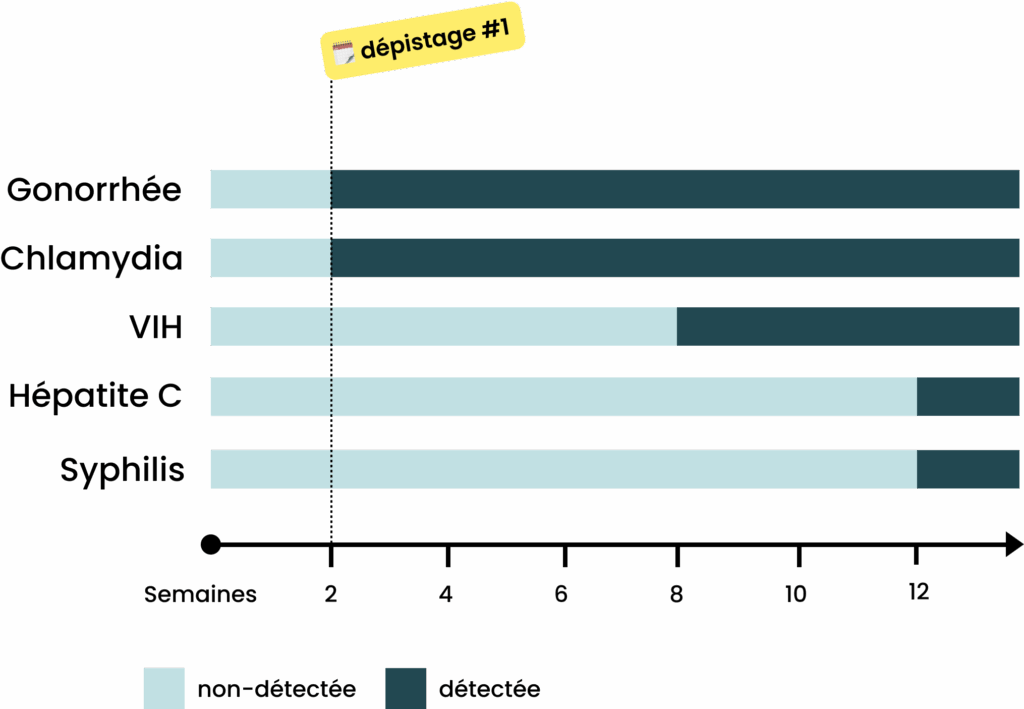
What they don’t know is that they actually contracted syphilis during that infamous party in September, two weeks before getting tested. Although her STI test result came back negative, her body simply hadn't produced enough antibodies for the infection to be detected in the laboratory. But even with this negative result, it's possible that she is already contagious and could transmit syphilis to her partners unknowingly.
That’s why it’s important to take a first test soon after a risky exposure , then a second test at the end of the window periodto make sure nothing was missed. And in the meantime? Keep taking care of yourself and others with safer sexual practices, so you can keep the fun without the worries!
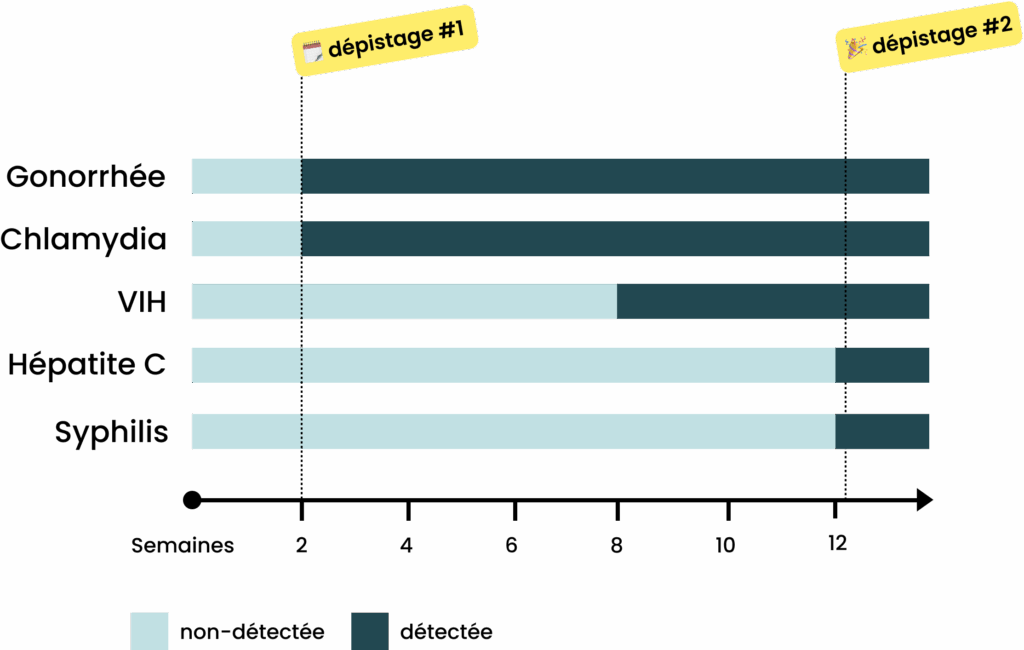
P.S. : Pas d’inquiétude pour notre personne imaginaire. Elle est retournée se faire dépister à la fin de la période fenêtre, a reçu un traitement antibiotique, et a pris le temps d’informer ses partenaires des derniers mois. Responsable, sereine, et toujours partante pour les galipettes. You goimaginary person!